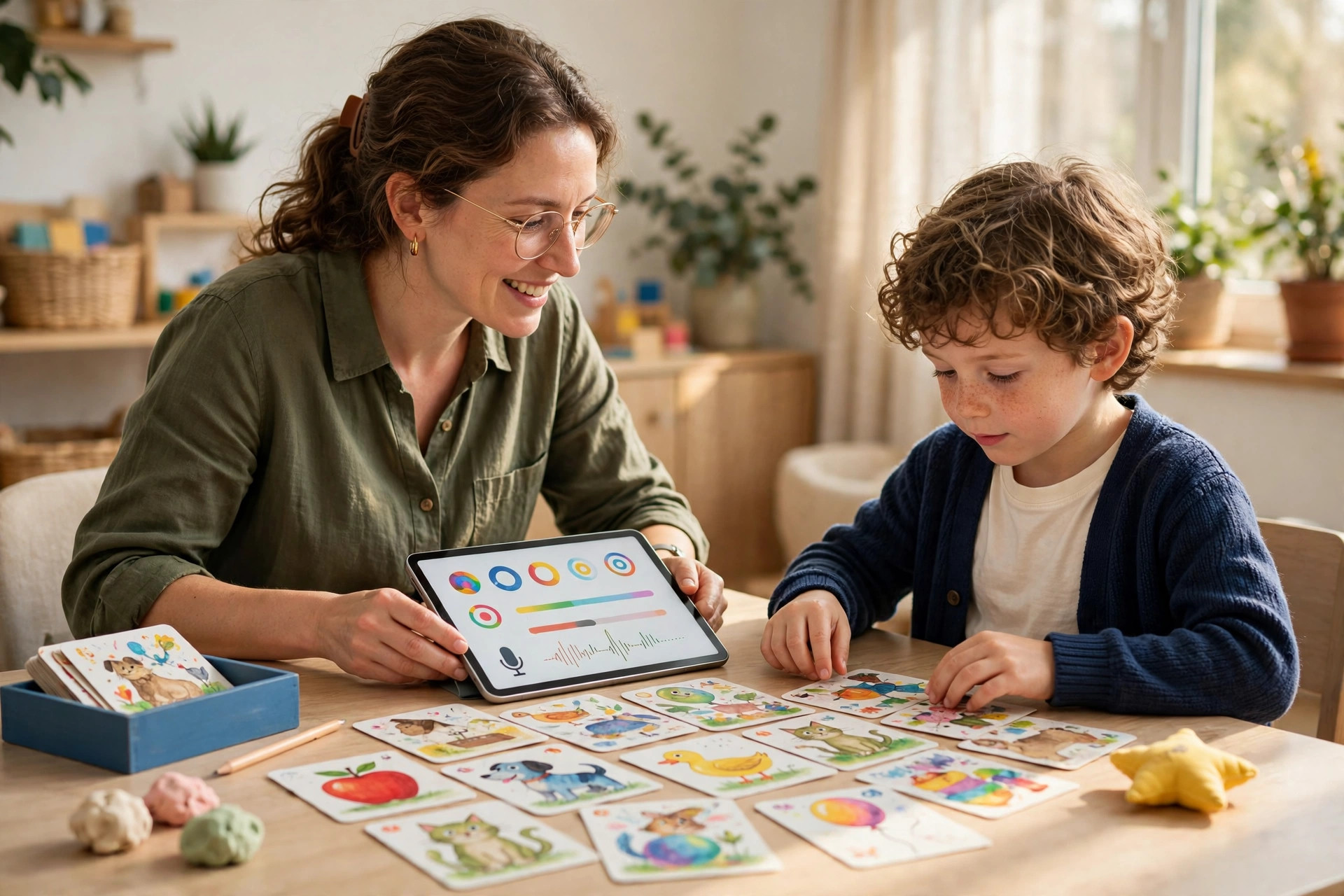
Speech-language pathologists spend hours every week on the paperwork around the therapy, not the therapy itself: session plans, word lists, parent letters, home-practice sheets and notes. A good AI prompt can turn that admin into a two-minute first draft — as long as you check every target word and never paste a real child's details into a chatbot. Here are seven copy-paste prompts for ChatGPT, Claude or Gemini that fit a working SLP's day.
How to Use These AI Prompts for Speech Therapy Safely
Before you copy anything, the privacy rule comes first. The American Speech-Language-Hearing Association (ASHA) advises that sensitive and personally identifiable information should not be entered into generative AI tools, and to assume a general chatbot is not HIPAA compliant unless your facility's privacy team has vetted it. So write every prompt about a profile, never a person: "a 7-year-old working on /r/ in the initial position" is fine; a name, school or birthdate is not. Dedicated SLP tools such as SLPFlow and SPRY Scribe offer AI-drafted session notes with HIPAA safeguards, while general assistants are best kept to de-identified materials and drafts.
1. Build a Session Plan in Two Minutes
Start the day with a plan instead of a blank page. This prompt turns a goal into a timed session outline with activities, materials and a data point to collect.
Act as a speech-language pathologist. Build a 30-minute session plan for a child aged 7 working on /r/ in the initial position at word level, moving to phrases. Include: a 5-minute warm-up game, two activities with target words, a simple data-collection table, and a 2-minute closing routine. List the materials I need.Use it for: morning prep, cover sessions and student placements.
2. Generate an Articulation Word List That Actually Works
Chatbots are genuinely useful for word lists — but this is also where their errors live, especially with sounds rather than spelling. Always ask for a phonetic transcription so you can catch mistakes before the list reaches a child.
Generate 20 single-syllable words with /s/ in the final position, suitable for a 6-year-old. Give each word with its IPA transcription, and flag any word that is also a minimal pair with /th/. Exclude words with consonant clusters.Use it for: articulation drills, minimal-pair work and homework sheets. Cross-check every transcription; tools like Articulation Station and Speech Blubs can then carry the verified list into practice games.
3. Write a Plain-Language Parent Letter
Plain-language rewriting is what these models do best, and it is the highest-value use in an SLP's week. One prompt turns clinical jargon into a letter a parent can actually act on.
Rewrite this therapy update in plain language for a parent, at reading age 10, in a warm and encouraging tone: [paste your de-identified summary]. Explain what their child practised, one thing that went well, and one 5-minute home activity. No clinical jargon, no abbreviations.Use it for: progress updates, home-practice instructions and end-of-term summaries.
4. Create a Home-Practice Sheet Families Will Use
Home practice only works if families understand it. This prompt builds a one-page sheet with clear steps and a tiny reward tracker.
Create a one-page home-practice sheet for a child practising /k/ at the start of words. Include: 10 picture words, a 5-minute daily game a parent can play at the kitchen table, three example sentences, and a simple tick-box tracker for the week. Keep the language simple and encouraging.Use it for: weekly handouts, holiday practice packs and teletherapy follow-ups.
5. Draft a Story for Language Goals
Short stories, scripts and social scenarios are strong first drafts at a set reading level — just check every target word against the goal before you print.
Write a 150-word story for a 9-year-old working on sequencing and past-tense verbs. The story should be about a school trip to a science museum, include at least 8 past-tense verbs, and end with three WH-questions (who, what, where) about the events in order.Use it for: narrative language goals, reading comprehension and social stories. Leveled-reading tools like Diffit and MagicSchool can adapt the same story to different reading levels.
6. Turn Session Notes Into a Draft SOAP Note
Documentation is the biggest time sink in the job. Feed the chatbot your own shorthand — never a recording or a named file — and let it shape a draft you review and sign.
Turn these de-identified session notes into a draft SOAP note for a speech therapy session. Keep it factual, use professional clinical language, and leave [brackets] wherever a number or observation is missing: [paste your shorthand notes]. Do not add any information I did not provide.Use it for: daily notes, progress reports and IEP documentation drafts. If your clinic bills insurance, a dedicated AI scribe such as SPRY Scribe or an EMR with an AI scribe like Ambiki may fit better, since they are built around signed BAAs.
7. Plan a Week of Thematic Vocabulary
When a theme runs through the week, one prompt can stock every session with vocabulary, categories and questions.
Plan a week of vocabulary activities around the theme "the garden" for a group of 5-year-olds working on categories and describing. Give me: 12 target words grouped by category, a describing-words game, a sorting activity, and two WH-questions per day for five days.Use it for: group therapy, classroom collaboration and themed units.
Related guides on NextGenAIVibe
- 7 AI Prompts for Physiotherapists: Daily Clinic Pack 2026
- 7 AI Prompts for Grant Writers: Daily Funding Pack 2026
- 7 AI Prompts for Teachers: Daily Lesson-Planning Pack 2026
Tags: #AIPrompts #SpeechTherapy #SLP #ChatGPT #AITools #Healthcare #Productivity
Comments (0)