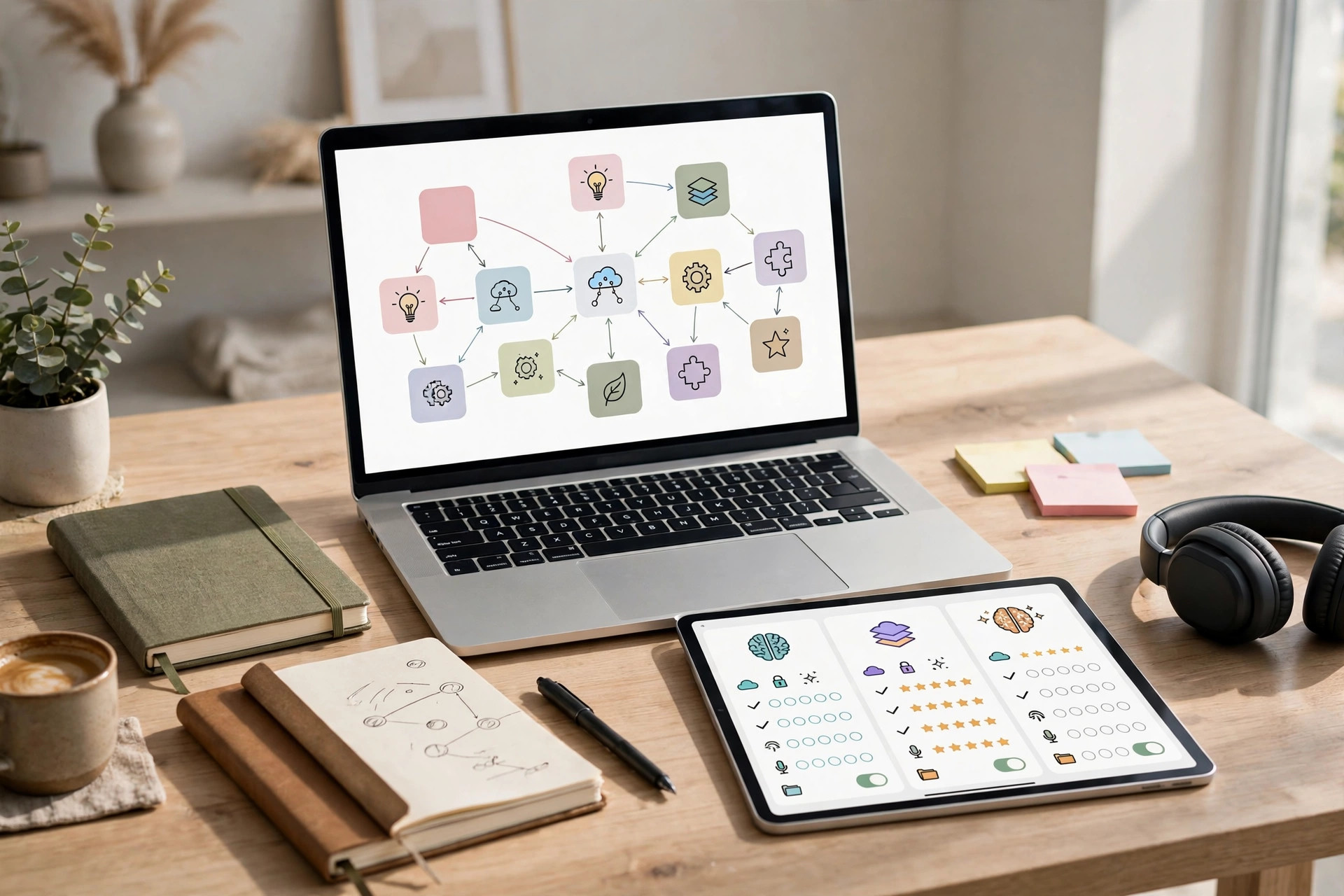
Choosing the best AI notes app in 2026 is harder than it looks, because the top tools no longer think alike. Tana thinks in structure, Capacities in objects, and Heptabase in space. That difference decides which one feels effortless for you. Here is the honest head-to-head.
Best AI notes app 2026: the head-to-head table
| Feature | Tana | Capacities | Heptabase |
|---|---|---|---|
| Best for | Meeting-heavy teams and structured knowledge | Solo thinkers who love typed, linked objects | Visual researchers and students |
| How notes work | Outliner with supertags and live queries | Objects such as people, books and meetings | Cards arranged on infinite whiteboards |
| AI included | AI credits and agents; unlimited MCP on Pro | AI assistant and chat connectors on Pro | AI agent over cards and PDFs; model choice rises by plan |
| Free plan | Yes, $0 | Yes, free Basic | No ongoing free plan; trial only |
| Entry paid price listed | Pro $15 per member/month billed yearly | Pro $9.99/month | Pro $8.99/month billed yearly |
| Weak spot | Steeper learning curve; cloud-centric | Team features stay minimal | Manual arranging; no free tier |
Prices above are the entry prices listed on vendor and review pages checked in November 2026. Always confirm the current price on the vendor site before you pay, as plans change often.
Tana: best AI notes app for structure and meetings
Tana turns every bullet into a typed, queryable node. Supertags let a note become a task, a person or a meeting, and live queries pull those items together automatically. Its current focus is meeting context: botless capture for Zoom, Teams and Google Meet, searchable history, and agents that prepare follow-ups. Choose Tana if your knowledge arrives through calls and you want your notes to behave like a database you can ask questions of. The trade-off is effort: Tana rewards people who design a system, and it can overwhelm anyone who just wants to jot.
Capacities: best for a calm, object-based second brain
Capacities organises everything as objects with properties, templates and links, captured through a simple daily note. A book, a person and a project each get their own type, so retrieval stays tidy without folder gymnastics. The free Basic plan is a complete notebook with sync, offline use and import/export, while Pro adds the AI assistant, smart queries and chat connectors for tools such as ChatGPT and Claude. Choose Capacities if you work solo and want structure without the steep climb. Teams should look elsewhere, because collaboration remains light.
Heptabase: best for visual thinking and deep research
Heptabase is built for learning. Notes become cards you drag, cluster and connect on whiteboards, alongside highlighted PDFs and video transcripts. An AI tutor and agent can then work across those sources, which makes it superb for essays, literature reviews and complex projects where seeing connections matters. Choose Heptabase if you think spatially and study hard topics. The trade-offs are real: there is no ongoing free plan, and arranging cards by hand takes time that the other two tools automate away.
Verdict: which AI notes app should you pick?
For AI power and team meetings, Tana wins. For solo note-taking at a fair price, Capacities wins. For visual research, Heptabase wins. Our overall pick is Capacities: its free plan covers the whole notebook and Pro costs $9.99 a month. Pick Tana if meetings drive your work, Heptabase if whiteboards suit your brain.
Related guides on NextGenAIVibe
- 10 Best AI Note-Taking Apps in 2026 (Ranked & Tested)
- How to Build a Second Brain with NotebookLM: Full Guide
- 10 Best AI Mind Mapping Tools 2026: Ranked & Tested
Tags: #AINotes #Tana #Capacities #Heptabase #SecondBrain #Productivity #AITools #NoteTaking
Comments (0)